Facilitating structural DNA nanotechnology with non-aqueous solvents
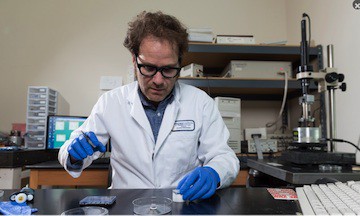
Recent research demonstrates that certain non-aqueous solvents can not only be used to assemble DNA nanostructures, but offer certain advantages over conventional aqueous solvents.

Recent research demonstrates that certain non-aqueous solvents can not only be used to assemble DNA nanostructures, but offer certain advantages over conventional aqueous solvents.
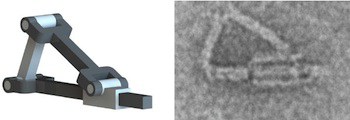
Scaffolded DNA origami is combined with hinges of single- or double-stranded DNA to built simple machines parts that have been combined to program simple to complex motions.
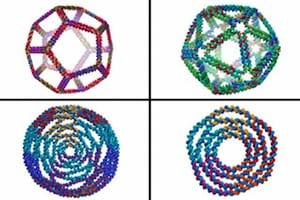
A more general computational framework predicts the structures of 2D and 3D-curved DNA nanostructures impossible to predict using previously available computational methods. May lead to 3D-printing DNA nanostructures?
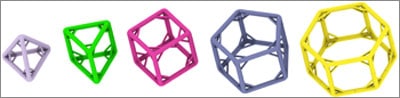
Using struts made of DNA to stiffen polyhedral corners, scientists have build rigid DNA cages an order of magnitude larger than previous DNA nanostructures, and only one order of magnitude smaller than bacterial cells.
Tiles made from DNA helices have been made to self-assemble into a more complex structure, which then was used to seed the formation of a complementary structure. This second structure in turn seeded the formation of multiple copies of the first structure.
Two independently controlled nanomechanical devices can be positioned on a two-dimensional DNA grid so that they can cooperate to capture between them one of four DNA building blocks, determined by which of two possible states each device is set to.
Researchers have been able to attach gold nanoparticles to DNA tiles and, by varying the size of the nanoparticles and the presence of DNA stem loops on some tiles, have been able to control the formation from the DNA tiles of various three dimensional DNA nanotubes.
Two basic structural motifs of DNA nanotechnology have been efficiently and inexpensively replicated in bacterial cells.
A new building block for structural DNA nanotechnology uses a 3-carbon glycerol molecule instead of the 5-carbon sugar deoxyribose found in DNA.
Three short DNA strands attached to one aromatic ring containing six carbon atoms form three-legged building blocks that assemble into a dodecahedron.