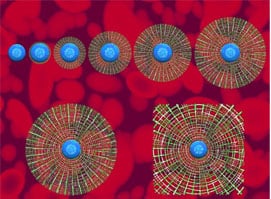
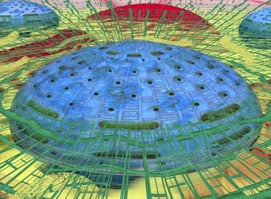
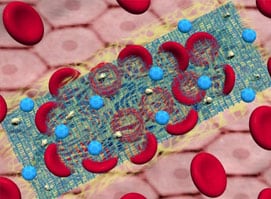
The artificial mechanical blood platelet or clottocyte may allow complete hemostasis in as little as ~1 second, even in moderately large wounds. This response time is on the order of 100-1000 times faster than the natural system. The baseline clottocyte, designed by Robert A. Freitas Jr., is conceived as a serum oxyglucose-powered spherical nanorobot ~2 microns in diameter (~4 micron 3 volume) containing a compactly-folded biodegradable fiber mesh. Upon command from its control computer, the device promptly unfurls its mesh packet in the immediate vicinity of an injured blood vessel – following, say, a cut through the skin. Soluble thin films coating certain parts of the mesh dissolve upon contact with plasma water, revealing sticky sections (e.g., complementary to blood group antigens unique to red cell surfaces) in desired patterns. Blood cells are immediately trapped in the overlapping artificial nettings released by multiple neighboring activated clottocytes, and bleeding halts at once.
While up to 300 natural platelets might be broken and still be insufficient to initiate a self-perpetuating clotting cascade, even a single clottocyte, upon reliably detecting a blood vessel break, can rapidly communicate this fact to its neighboring devices, immediately triggering a progressive carefully-controlled mesh-release cascade. Clottocytes may perform a clotting function that is equivalent in its essentials to that performed by biological platelets, but at only 0.01% of the bloodstream concentration of those cells or about 20 nanorobots per cubic millimeter of serum. Hence clottocytes appear to be about 10,000 times more effective as clotting agents than an equal volume of natural platelets.