
0
    0
    Your Cart
    Your cart is emptyReturn to Shop

        Atomically-precise positioning of a single atom transistor-VIDEO

        Researchers in Australia and the US have demonstrated a working transistor by placing of single atom of phosphorous with atomic precision between gates made of wires only a few phosphorous atoms wide. This demonstration points to possibly extending current computer technology to the atomic scale.
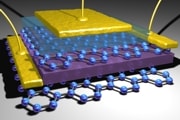
        Graphene heterostructures may lead to graphene-based computer chips

        A field-effect tunneling transistor comprising a vertical heterostructure of atomically thin layers of graphene and boron nitride or molybdenum disulfide may pave the way for computer chips based on graphene nanotechnology.

        Magnetic storage systems shrink from a million atoms per bit to twelve

        An array of 96 iron atoms on a copper nitride surface, assembled using an STM and used to write a byte, demonstrates how small magnetic storage could shrink and may lead to novel nanomaterials for quantum computers.

        A molecular switch with a single proton switched by a single electron

        How small could a molecular switch be made? It is difficult to think of one smaller than the single proton switch just demonstrated by this group in Germany.

        Foresight@Google: Full Program of Speakers posted!

        We are proud to announce our final conference program for Foresight@Google‘s 25th Anniversary Conference Celebration, held June 25-26 in Mountain View, CA. ย For $50 off registration use code: NANODOT This weekend – full of plenary talks, panels, and breakout sessions – is a unique opportunity to be stimulated, enlightened and inspired by direct interaction with… Continue reading Foresight@Google: Full Program of Speakers posted!

        A modular molecular composite nanosystem for solar power

        A bacterial virus called M13 was genetically engineered to control the arrangement of carbon nanotubes, improving solar-cell efficiency by nearly one-third.

        Promise and challenge on the road to practical graphene electronics

        Smaller, faster, cooler: graphene transistors show promise for practical analog signal processors, for magnetic memory devices, and for self-cooling electronic circuits.

        Controlling the orientation and stretching of DNA attached to a surface

        A shear flow processing method has been developed to control the surface attachment and orientation of DNA molecules to use for DNA-organic semiconductor molecular building blocks.

        Positional control of chemical reaction a step toward advanced nanotechnology

        A step toward advanced nanotechnology has been achieved by using attachment to a surface and confinement by surrounding molecules to make two molecules react to form a product that would not form if they were free to react in solution.

        Atomically precise graphene nanotechnology

        Sputtering a pattern of zinc atoms on a graphene surface, followed by an acid rinse to remove the zinc, also removes exactly one atomic layer of graphene from where ever the graphene was covered with zinc atoms, forming a pattern on the graphene surface that is atomically precise in the vertical dimension. Resolution in the horizontal dimensions is determined by the mask used to sputter zinc.