
Silicene: silicon's answer to graphene
**Updates: July 2014 — Research out of Argonne National Lab suggested that silicene may have never actually been successfully synthesized, rather that spectra indicate a mixture of silicon and silicon-substrate alloy; see article on Phys.org.
August 2014 — Research out of Italy suggests that their spectra establish the presence of silicene though not in a monolayer, rather in multilayers sandwiched between oxidized top layers and alloy lower layers; see this article also at Phys.org which currently contains a link to the full paper. **
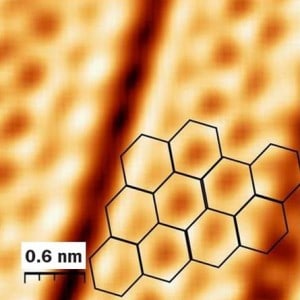
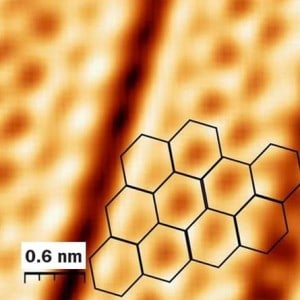
On the list of potential post-silicon materials for electronics and chips is none other than silicon. More specifically, silicene — 2D sheets of hexagonally arranged silicon atoms, structurally analogous to graphene and experimentally characterized by physicist Guy Le Lay of Aix-Marseille University in France (2012 abstract here).
While graphene possesses exceptional performance qualities, it can’t be directly swapped in to existing silicon-based industry and technology. As described last year in the ExtremeTech article Silicene discovered: Single-layer silicon that could beat graphene to market:
Unlike silicon (or germanium)*, graphene doesn’t have a bandgap, which makes it very hard to actually build a switching device — such as a transistor — out of it. Researchers have had some luck in introducing a bandgap, but graphene is still a long way away from being used in current silicon processes.
Silicene … should be compatible with silicon-based electronics and the huge, existing semiconductor fabrication processes.
*Speaking of germanium, if you’re wondering whether it’s getting a piece of the action the answer is yes. See the companion post Germanane: germanium’s answer to graphane.
So, while the prospects of graphene-based devices are still tremendous, other materials that might allow more near-term integration into existing systems remain attractive.
But the honeycomb lattice may be silicene’s only resemblance to graphene. In the recent Nature news article Sticky Problem Snares Wonder Material, silicene is described as a “super sticky” material that “crinkles into bumps and ridges.” Before silicene’s theoretical properties can be experimentally tested, stable sheets of silicene need to be fabricated. A number of labs are working on it (find graphics and references in this pdf of a talk by Prof. Le Lay), and silicene is being included in more research programs under the graphene/honeycomb lattice umbrella.
What fascinates me most is the notion that a material on the nanoscale could replace its own bulk-scale counterpart for advanced, future applications – a great example of the wonder of the nanoscale. We may need to revise the term “post-silicon” to “post-bulk-silicon”.
-Posted by Stephanie C